

9 min read
Fifty times in our last 335 sales calls, an owner told us some version of the same thing: we're too small for $5,500 a month.
Some of them were right.
Marketing cost isn't one number. A $2M remodeler trying to hit $2.5M and an $8M custom builder aiming for $10M need very different budgets, and very different help. Get it wrong in one direction and you starve the pipeline. Get it wrong in the other and you hand an agency the money you needed for payroll in February.
In this blog, we explain how much remodelers and custom home builders should spend on marketing from $1M to $5M and up, what that money actually buys at each stage, and how to tell whether your budget is working.
Table of Contents
- The Short Answer: 3 to 5% of Your Revenue Goal
- What Actually Counts in a Marketing Budget
- How We'll Use Our Own Pricing
- What Marketing Costs From $1M to $3M
- What Marketing Costs From $3M to $5M
- What Marketing Costs at $5M and Up
- How to Tell If Your Marketing Budget Is Working
- Signs Your Marketing Budget Fits Your Business
- How Builder Funnel Approaches Marketing Budgets
- FAQ
- Run Your Own Numbers
The Short Answer: 3 to 5% of Your Revenue Goal
Most remodelers and custom home builders should budget 3 to 5% of their revenue goal for marketing each year, with at least half of it going to digital.
That's the math I give every owner who asks. The important word is goal. If you budget off this year's revenue, you're funding the company you already have. Budget off where you want to be next year and the spend lines up with the work it takes to get there.
For context, JLC's report on the 2018 Remodeling 550 found the biggest full-service remodeling firms average about 3% of revenue on marketing. Those are firms that already made it. If you're trying to grow, aim for the same range against a bigger number.
At three stages, it looks like this. The goals are examples, so swap in your own and keep the percentage.
|
Where you are today |
Example |
Yearly budget (3 to 5% of goal) |
Per month |
Digital (at least half) |
|---|---|---|---|---|
|
$1M to $3M |
$2M, aiming for $2.5M |
$75,000 to $125,000 |
about $6,250 to $10,400 |
$37,500 to $62,500 a year |
|
$3M to $5M |
$4M, aiming for $5M |
$150,000 to $250,000 |
about $12,500 to $20,800 |
$75,000 to $125,000 a year |
|
$5M and up |
$8M, aiming for $10M |
$300,000 to $500,000 |
about $25,000 to $41,700 |
$150,000 to $250,000 a year |
If the number on your row made you wince, hang on. There's a section for that.
Want help running these numbers for your company? Book a 30-minute call with Tony and our team. We'll work the math backward from your goal and tell you which stage you're really in.
What Actually Counts in a Marketing Budget
Your marketing budget is everything you spend to win the next job: outside help, software, ad spend, offline marketing and people.
When someone hears "$5,500 a month," they're usually hearing three or four different bills rolled together. Here's how they split out, and how the lines shift depending on whether an agency or your own team does most of the work. Plenty of companies run both: an in-house coordinator who owns the calendar, reviews and events, plus an agency for the website, SEO and ads.
|
Line item |
What it covers |
Agency does most of the work |
In-house person plus an agency |
|---|---|---|---|
|
Agency or freelancer fees |
Strategy, content, website, SEO, ad management |
Your biggest line |
Smaller, because the agency covers a narrower scope |
|
People |
A marketing coordinator or manager on payroll |
Usually none |
Often the biggest line once you count salary |
|
Technology |
CRM, website hosting, tracking, email tools |
Same either way |
Same either way |
|
Ad spend |
What you pay Google and Meta for ads |
Same either way (at Builder Funnel it's always a separate line from our retainer) |
Same either way |
|
Offline |
Home shows, yard signs, truck wraps, events, client gifts, the showroom |
You or your office manager |
Your coordinator |
Either way, every line counts against the same 3 to 5%. That's why the digital half matters. The other half pays for the people, the referral engine and the brand that's probably already working for you.
How We'll Use Our Own Pricing
We'll run each budget against Builder Funnel's published prices, because they're public and they make the math concrete.
Any agency's numbers would work the same way, and you can compare the best marketing agencies for remodelers and home builders side by side. The point is to see how much of each budget outside help takes, and how much is left over for ad spend, people and the offline marketing that already brings in referrals. Our prices are on our pricing page if you want to check them.
What Marketing Costs From $1M to $3M
From $1M to $3M, a realistic marketing budget is about $75,000 to $125,000 a year for a $2M company, and at least $37,500 to $62,500 of that should go to digital.
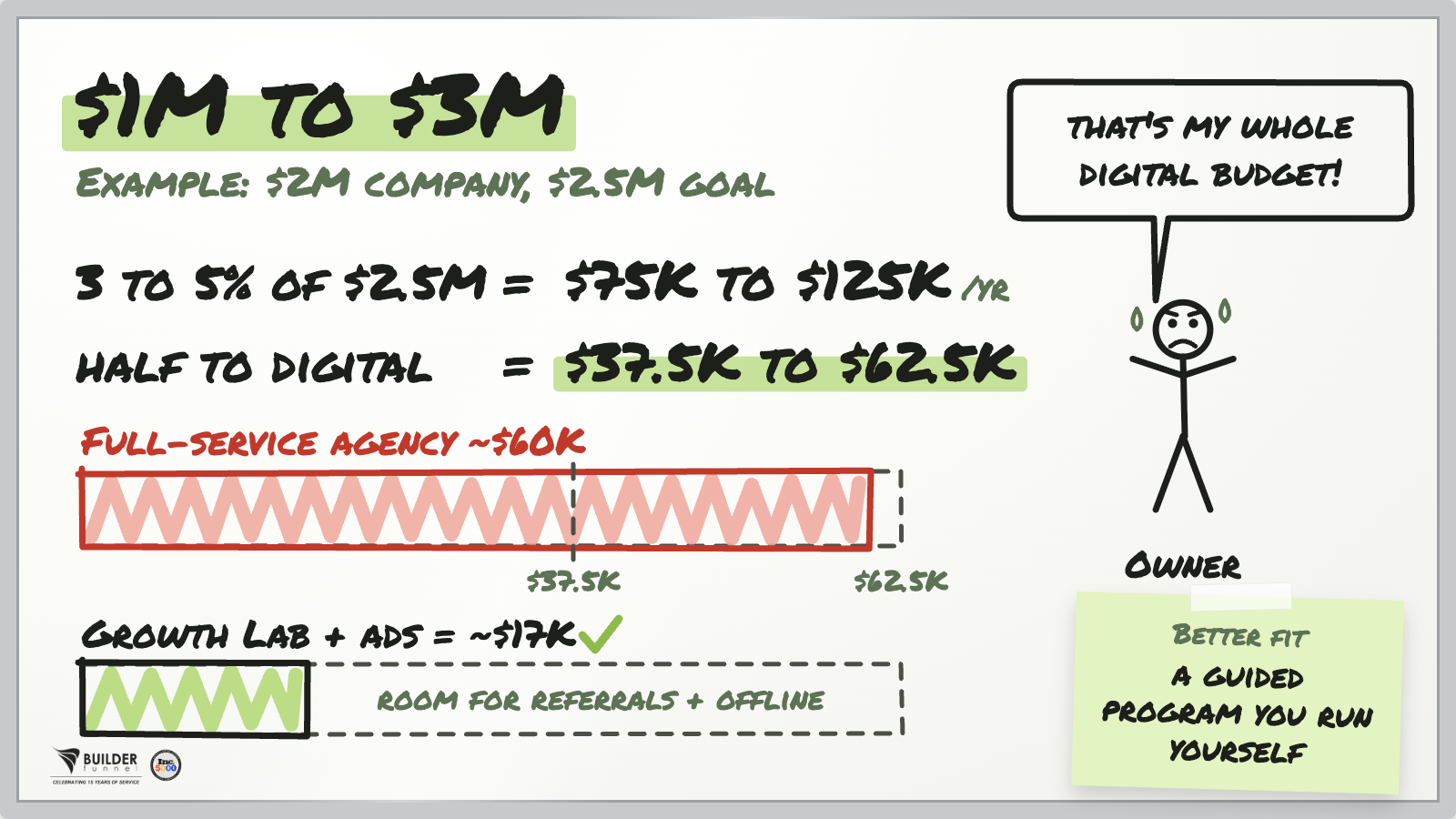
Here's what full-service agency help costs against that. With us, the foundation (website, SEO, CRM, lead generation, tracking) starts at $15,000, paid over the three months it takes to build. After that, a retainer, technology and a modest ad budget run about $5,000 a month. Year one lands right around $60,000.
Put that next to the digital half. For a $2M company, $60,000 takes almost all of it, or more than all of it. At $1M it's two to three times the digital budget. Full service would eat the budget before you've paid for a single yard sign.
Yes, at this stage you're probably too early for full service. That's not a knock on your business. It's math.
What to Do Instead at This Stage
Put the digital half toward a system you run yourself, with coaching, and keep the referral engine fed.
That's why we built the Remodeler Growth Lab. It's a year-long guided program for owners who want a real marketing and sales system but aren't ready for an agency: four live calls a month, playbooks and templates, and about two to three hours a week of your time. It's $5,000 a year, or $500 a month.
Run the same math. $5,000 for the Lab plus $1,000 a month in ad spend is $17,000 a year. That sits comfortably inside the digital budget, with room left for whatever's already bringing in referrals.
The firms that do this well under $3M usually get three things right first:
- They know where every lead came from, so next year's budget isn't a guess.
- Their Google Business Profile and reviews look as good as their work.
- Their website turns a curious homeowner into a booked call instead of a bounce.
What Marketing Costs From $3M to $5M
From $3M to $5M, plan on about $150,000 to $250,000 a year for a $4M company, and this is where an agency partnership starts to fit.
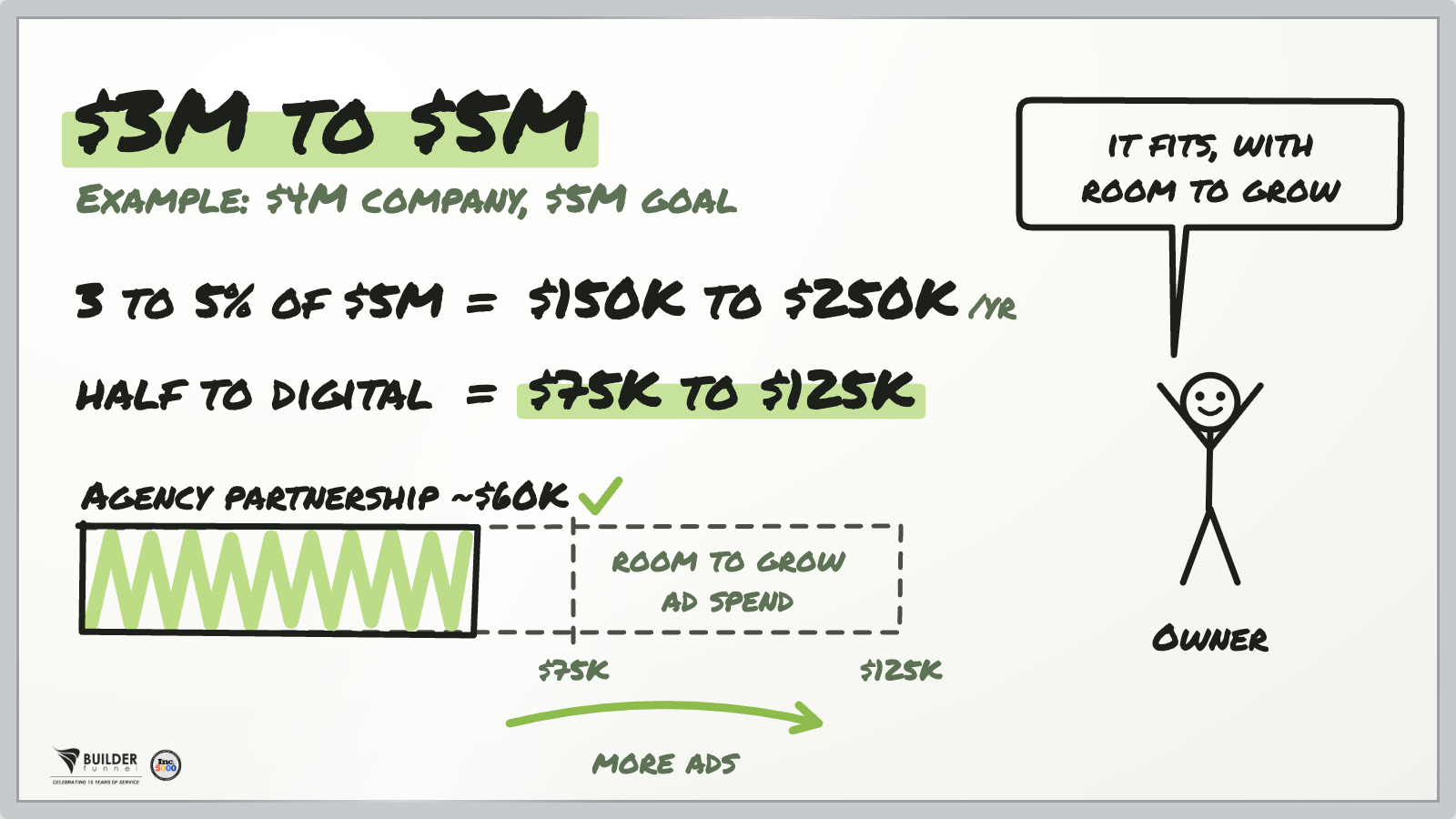
The digital half is $75,000 to $125,000. That same roughly $60,000 a year (retainer, technology and starter ad spend) now fits inside it, with room left to grow ad spend on whatever's working, keep the referral engine fed, and test a new channel without betting the budget on it.
The question at this stage is less "can we afford it" and more "how many more jobs do we need, and what does each one cost to win?"
Run the Math Backward Before You Pick a Number
The cleanest way to check a budget is to start from the projects you need and work back to the leads.
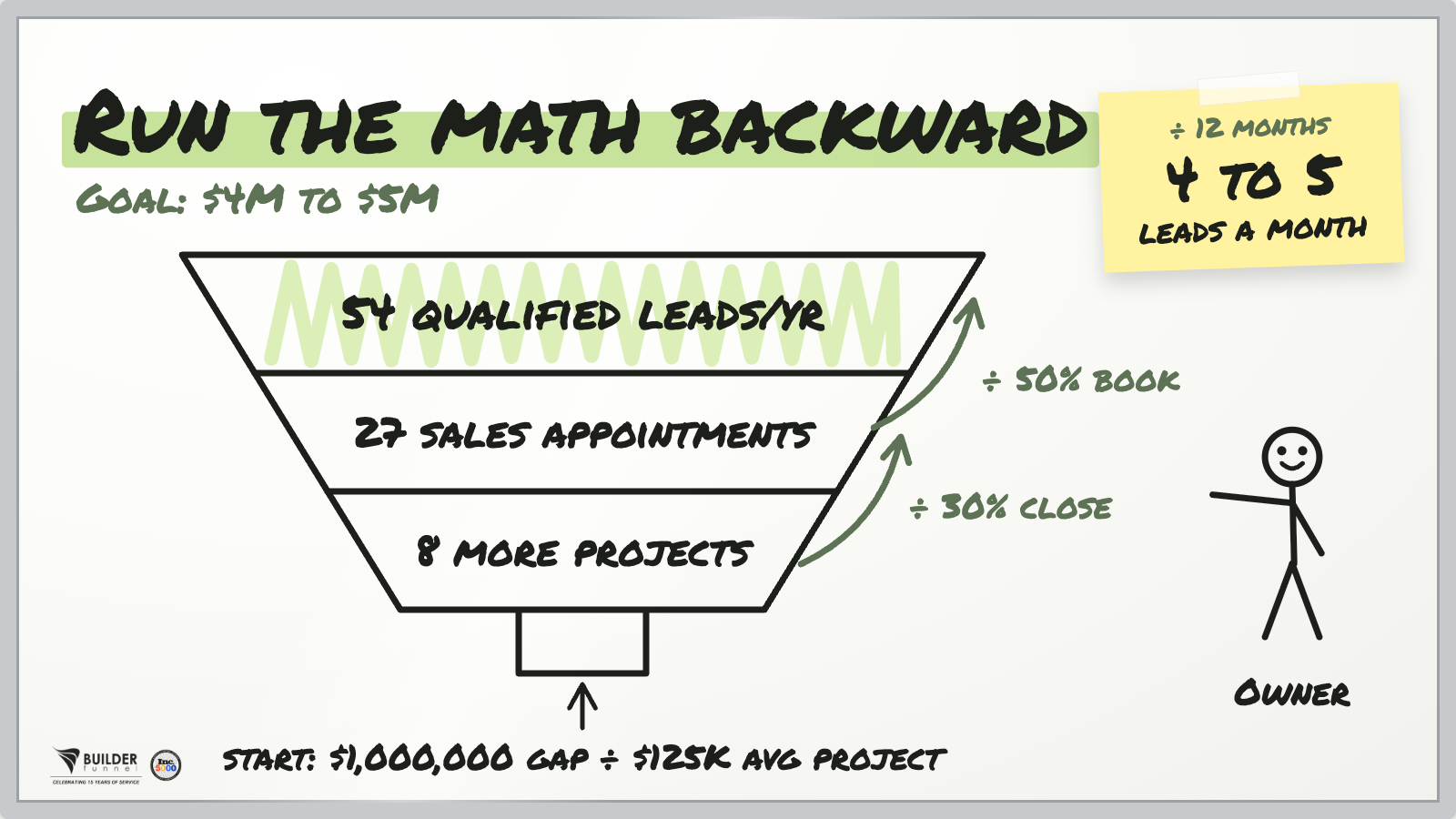
This is the version I'd sketch on a whiteboard for a $4M remodeler trying to hit $5M. The inputs are examples, so use yours:
- Revenue gap: $1,000,000
- Average project: $125,000, so you need 8 more projects
- Close rate: 30%, so you need about 27 sales appointments (8 ÷ 0.30, rounded up)
- Booking rate (leads that turn into appointments): 50%, so you need about 54 qualified leads a year
That's 4 or 5 qualified leads a month on top of what you're getting now. Divide the extra spend you're adding by 54 and you've got the most you can pay for each new qualified lead and still hit the goal.
If you can't fill in your close rate, that's the first fix. It's cheaper than any ad.
What Marketing Costs at $5M and Up
At $5M and up, the budget runs about $300,000 to $500,000 a year for an $8M company, and the job is making sure every channel pulls its weight.
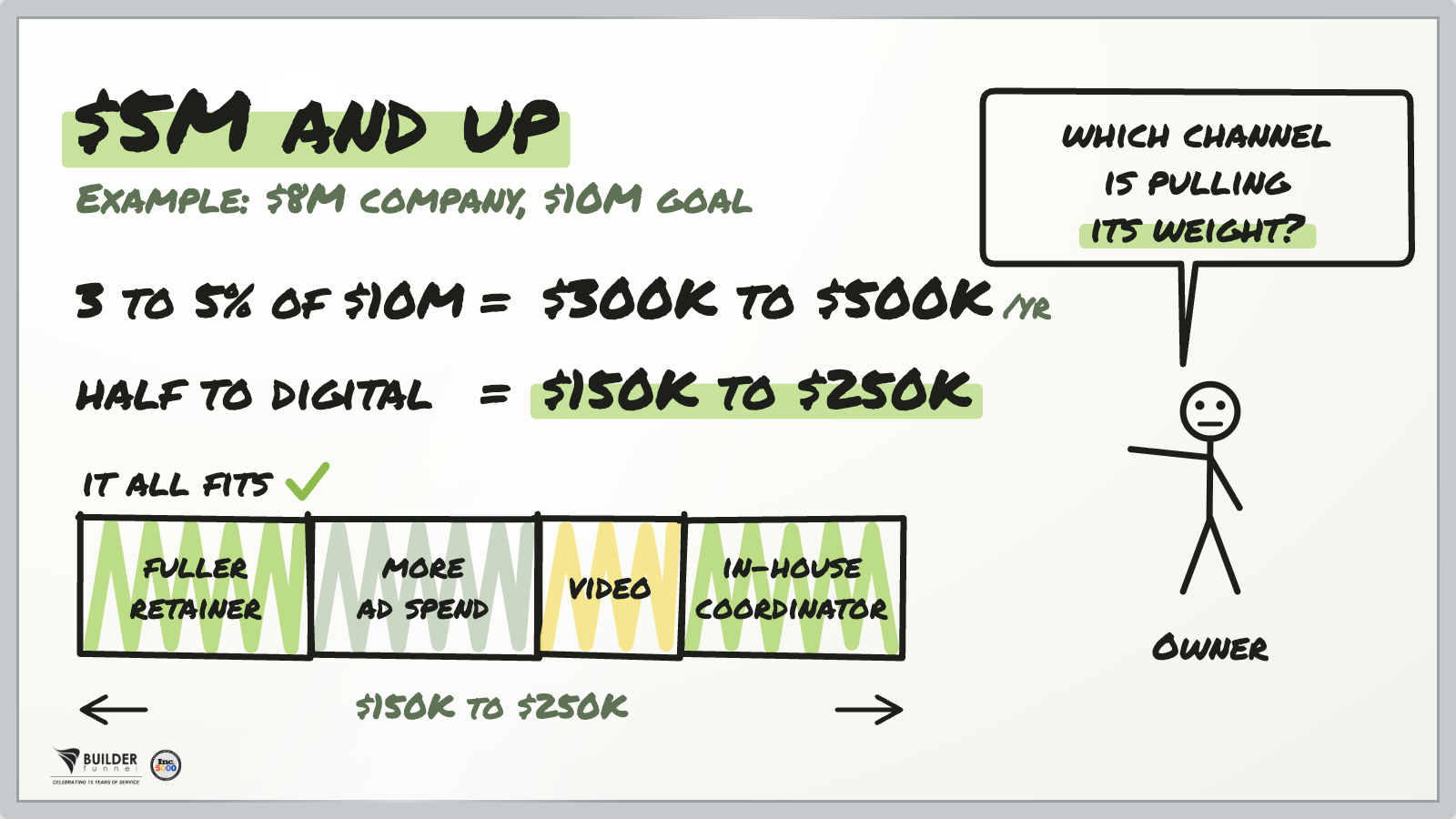
The digital half alone is $150,000 to $250,000. A fuller agency retainer (ours run $5,000 to $7,500 a month, with ad management up to $25,000 a month in spend) still leaves room. At this size the extra usually goes to three places:
- More ad spend, scaled only where the cost per signed job holds up. If search is on the list, here's whether Google Ads work for contractors and home builders in 2026.
- Video and content. Filmed project walkthroughs, long-form videos and short clips do a lot of the selling before the first meeting. For how much of the budget to put toward video, see Your 2026 Video Budget.
- People. A marketing coordinator on your team who owns the calendar, the reviews and the handoff to sales.
At this stage, the bigger risk is spending a lot without knowing which half is working.
How to Tell If Your Marketing Budget Is Working
Before you spend more, compare what a customer is worth to what it costs you to win one.
That's your LTV:CAC ratio. LTV (lifetime value) is the gross profit a client brings you over the whole relationship. CAC (customer acquisition cost) is everything you spent on marketing and sales, divided by the number of new clients it brought in.
A quick example with round numbers:
- A $100,000 remodel at 30% gross margin is worth $30,000 in gross profit.
- You spent $96,000 on marketing last year and signed 8 new clients from it. CAC is $12,000.
- $30,000 ÷ $12,000 = 2.5:1
Then read it like this:
- Under 3:1: fix the engine before you add fuel. Usually the fix is lead follow-up or close rate.
- 3:1 to 6:1: you're healthy. Scale carefully and keep measuring.
- Over 6:1: you're probably underspending. You can likely raise the budget a lot.
Cheap leads can make this ratio look worse than you'd expect. We walk through why in The Hidden Truth Behind Remodeler Lead Generation.
Improve, Then Increase
Move money to what's working before you add more money.
Split last year's spend by channel. Take budget from the weakest one and give it to the strongest. Then raise the total. If cash is tight, raise it about 50% instead of doubling it overnight.
Signs Your Marketing Budget Fits Your Business
Your budget fits when you can explain where every dollar went and what it brought back.
You're probably in good shape if:
- Your budget is based on next year's goal, not last year's revenue
- You know your cost per qualified lead by channel
- At least half the budget goes to digital, and you can see what it produced
- Your agency fee, tech, people and ad spend are separate lines you can read
- Your LTV:CAC is 3:1 or better
- You know your close rate within a few points
It's time to rethink the setup if outside help eats the whole budget, nobody can tell you which channel signed last quarter's jobs, or you've doubled spend twice without doubling leads.
How Builder Funnel Approaches Marketing Budgets
We start every budget conversation from your revenue goal and your real numbers, and we tell you when we're the wrong fit.
For 16 years, we've only worked with remodelers and custom home builders, and we've tracked more than $250M in results for them. That focus is why our prices are on our pricing page instead of hidden behind "contact us for a quote," and it's why our marketing system for remodelers and custom home builders starts with your goal.
It's also why we'll point a company under $3M to the Remodeler Growth Lab instead of selling them a plan that eats their whole digital budget. We'd rather work with you when the numbers work for you.
One more thing, so there are no surprises: marketing takes time to pay back. Plan on 6 to 12 months before a new strategy starts bringing in leads, and 9 to 18 months before it pays for itself in signed jobs. Most companies close their first deal from a new strategy in 9 to 12 months, and we walk through that timeline in How Long Until Marketing Pays Off for Remodelers and Custom Home Builders. It's also why the cheapest option rarely ends up cheapest, which we cover in Why Cheap Marketing Gets Expensive Later.
FAQ
What does marketing cost for remodelers and custom home builders at $1M, $3M and $5M+?
Using 3 to 5% of a growth goal, a $2M company aiming for $2.5M should plan on $75,000 to $125,000 a year, a $4M company aiming for $5M on $150,000 to $250,000, and an $8M company aiming for $10M on $300,000 to $500,000. At least half of each should go to digital.
Should I base my marketing budget on current revenue or my revenue goal?
Base it on your goal. Budgeting off current revenue funds the business you already have, and the gap between that number and your goal is exactly the work marketing has to do.
Does an in-house marketing person count against the budget?
Yes. A coordinator's salary is part of what you spend to win the next job, so it comes out of the same 3 to 5%. Many companies pair one in-house person with an agency, which shifts the split but not the total.
Is ad spend included in a marketing agency's retainer?
At Builder Funnel it isn't. The retainer, technology and ad spend are always separate lines. Ask any agency you talk to how they split it, because some fold ads into one number and you can't see what's working.
What if I can't afford 3 to 5% of my revenue goal?
Start with what you can and stretch the timeline. Hitting your goal in two or three years beats never investing and never getting there. If you're under about $3M, the Remodeler Growth Lab is built for exactly that stage.
Run Your Own Numbers
Our tables use example goals. Yours is the one that matters.
Book a 30-minute call and we'll run the reverse math with your goal, your average project and your close rate. You'll leave knowing which stage you're in and what a realistic budget looks like for you, whether or not we're the right fit.
Free on-demand training
Watch the Growth Framework webinar
The system behind $250M+ in booked work for custom home builders and remodelers, step by step.
Watch the Free Training